Wednesday, 17 July 2019

Can hotels win the booking?


In the battle to win customers to direct channels, hotels need to adopt a multi-pronged strategy finds new report.

Hotels are struggling to win direct bookings in a hyper-competitive age of online travel booking. However, there is still room to improve performance and make major headway in this important arena by reaching consumers in the channels that matter and perfecting those channels for maximum effectiveness finds a new report. The State of Hospitality Distribution: Direct report, which is free to download now, notes that hotels that focus the efforts on a carefully crafted strategy across Search Engine Optimisation (SEO), metasearch, their own sites, loyalty programs and social media and User Generated Content (UGC) stand a good chance of boosting their direct bookings.


Looking at what tactics are viewed as most critical amongst the travel industry, SEO, content marketing and social are seen as the most critical for customer acquisition. The report notes an EyeforTravel industry survey, which found that travel suppliers reported that their top area of investment for customer acquisition is SEO, at 54% of respondents, followed by content marketing at just under half of respondents and then social media and blogs. Reinforcing the importance of SEO and social, as well the pervasiveness of the most powerful advertising networks on the internet, 63.7% of travel suppliers said that Facebook and Google were positive influences that help their businesses.

It is therefore critical that hoteliers address these fields. When it comes to SEO, the game has to be played cleverly as more generic keywords reaching the broadest segment of the market are already likely to be subject to fierce bidding and therefore difficult to generate strong returns from. The report suggests that hoteliers need to research their field of keywords, focusing on long-tail keywords more specific to their properties, as well as the following:
        Move to a responsive website: Responsive sites help with ranking as it is easier for search engines to crawl and uses a single URL, and Google has tweaked its algorithm with the release of Hummingbird to be more focused on the mobile experience.
        Look at code and content carefully to reduce page load times: Look at page weight and figure out where the biggest strains are as well as where there might be smaller savings. Approach imagery in a smart manner, looking to compress, run off an image server, and combine background images into a single image to reduce requests. Consider a Content Delivery Network (CDN) to reduce latency.
        Think about user purpose at all stages: Consider the user intent at all stages and make it easy for them to navigate to the next step.
        Create quality, original content: Focus on being trustworthy and authoritative. Poorly conceived and created content will mean low dwell times, a lack of backlinks, high bounce rates, and poor ClickThrough Rates (CTRs). Create content hubs related to your destinations or offerings that interlink with each other and answer specific things that visitors would want to know about the area or service.
        Remember search engines are mostly text-based and you need to make their lives easy: Look at underlying structural data that can help engines and therefore your position. These include: meta titles, meta descriptions and header tags, particularly the H1 tag, that use keywords appropriately and help describe the page; alt tags, related file names and descriptions for key images; and provision of a sitemap to Google.
        Set up a Google Search Console account: Google’s Search Console is an incredibly helpful tool to track site performance and organic SEO.

Alongside SEO, social is highly influential, particularly in initial phases of thinking about and researching a trip, most notably among younger consumers. “Social media plays a big part in who we are and how we reach new audiences,” said Kate Martin, General Manager of the Luma Hotel Times Square in New York City. “Because we’re new and hip, we find and connect with customer who appreciate us for being different and social media is a big part of that.”

Jason Lee, Senior Director of Product and Technology at Travel Media Group, finds that social media and in particular Facebook affect all phases of the buying process, with “Facebook delivering the most bang for the buck because there’s nothing like it in the social media sphere.”

Lee’s strategy for hotel clients is to both invest in promoted content and ads and to create content that builds engagement. Consumers will likely use social media as a research tool, going elsewhere to book and largely ignoring Calls to Action (CTAs) except when closely targeted, such as at choice moments of heightened interest. For one hotel client, Lee spent $10 on a Facebook post promoting room availability during dates when a high-profile artist was giving a concert at a venue near the property. Within minutes of the post going live, it was viewed several hundred times, shared 87 times and generated seven room nights.

Some of the above principles for social and search should be applied to the hotel’s website itself, which is perhaps the most crucial element of driving direct bookings. Similar to social, imagery is critical. For Sonesta International Hotel Corporation relaunch of its website it took the route of going “Much more visual that what we had previously,” said Scott Weiler, vice president, marketing and communications at Sonesta. “We commissioned a lot of new photos so that the site would be in lock step with the look and feel of the hotels.”  Much of the website balances a single hero image across the top of a page with tiles that Weiler described as visually providing users with a way of navigating a number of ideas very quickly

Honolulu-based Aqua-Aston Hospitality chose to position itself on its website as a Hawaii destination expert in addition to offering lodging facilities. Travel suggestions are tailored to users’ preferences and content themes change regularly and are tied together with customized itineraries created by local influencers and ambassadors. The company also amasses user data as they spend time exploring the site; that information is used to improve target marketing capabilities, serve up more relevant offers to users and further build its Customer Relationship Management (CRM) system and loyalty program.

It is the last point that is also perhaps being overlooked currently as the report finds that the loyalty program and hotel loyalty in general are not dead.

Loyalty programs continue to drive value for brands, attracting the highest spending consumers, driving positive views of the brand and being a way to reach younger consumers, surprisingly.
Over 90% of travel organizations believe that their loyalty program has had a positive effect on their brand’s perception among consumers according to an EyeforTravel industry survey featured in the report.

The results also note that 78.5% of hoteliers reported that their loyalty program members spent more than the average, with 30.8% reporting that they spend ‘considerably more’. In a consumer survey also within the report, membership for loyalty programs was skewed to higher income brackets, explaining this higher spend.


Furthermore, satisfaction regarding hotel loyalty programs was highest among the youngest age group. More than 80% of those aged 18 to 35 and members of at least one program think that hotels provide good or excellent service when it comes to loyalty membership. This declines to 73.8% for those aged 36 to 55 and 65.4% for over 55s.

Even better, the most engaged members are those aged 18-35. In this demographic cohort 70.3% report that they use their rewards on all or most of their journeys, falling to 66.1% from the middle-aged group and then to 51.8% for those over 55

This suggests that there is enormous value to be mined from a well-run loyalty program in targeting key groups of consumers and understanding the brand’s customer base, as well as generating repeat bookings.

For more, download the report now to get the inside track on direct bookings. This report features:
  • Industry and consumer survey data from hundreds of travel suppliers and thousands of consumers
  • Viewpoints from major hotel chains and independents on key tactics
  • Analysis of the state of direct booking rates to benchmark your performance against
  • Tactics to improve direct channel booking rates and increase loyalty
  • Strategies to increase channel visibility and get more guests into your funnel.

This report is part of the State of Hospitality Distribution Report Series. In this we cover metasearch, direct and OTA channels, assessing the health and landscape of each before giving you the information to maximise their effectiveness. Keep an eye out for our upcoming OTA report and click here for the metasearch report.

Monday, 15 July 2019

Hotels no longer own their guests


Reaching the consumer is absolutely critical but hotels are failing to capture enough of the market and are paying the price says new report.

According to an EyeforTravel industry survey, which captured nearly 800 responses from travel suppliers, OTA ownership of the customer is the single biggest external challenge they face. The results featured EyeforTravel and Fornova’s new The State of Hospitality Distribution: Direct report, which is free to download now, show that hotel brands are struggling to reach the consumer and get them to make a direct booking, with the fierce competition hurting revenues.

This can be seen in the soaring cost of acquisition. When EyeforTravel asked travel suppliers what issues were standing in the way of getting their products in front of customers, cost of acquisition came top at 43.4% of respondents, followed by another highly relevant issue to the direct question: Intermediaries.


The position of intermediaries as the supreme sellers of hotel rooms has put hotels at a disadvantage, in large part due to the accumulation of data expertise, along with the resources to interrogate and fully utilize the findings in marketing campaigns.

OTAs have an advantage that hotels continue to struggle to match, from proper data analytics to being overmatched in PPC campaign spending.

The net result of this is that the major OTAs have created a sense of brand loyalty among travel consumers and created a powerful market position. In a consumer survey of more than 5,000 travelers from Australia, Canada, the UK and the US also featured in the report, OTAs came out strongly ahead of hotel and traditional travel agencies for driving consumer bookings. Expedia, Booking.com and Hotels.com were the brands attracting the most repeat bookings, far ahead of the big hotel brands, with Best Western, Hilton and Marriott the best performing of these but still far behind the OTAs.

This means hotels needs to look more carefully at how they attract and retain business from consumers, considering profit per guest and customer lifetime value, as well as the value of owning the data from each guest.

“The question is, do you look at it from the perspective of operational results, which means profitability for the transaction, or from the point of view of lifetime customer value or customer retention?” Posited Sanchit Rege, manager, distribution strategy at Hyatt Hotels Corporation. “Even if I have to spend five extra dollars [on metasearch costs] for someone to book direct, I have an advantage over the other transaction because now I know who this person is before he arrives and I have the ability to drive profitability on my food and beverage or some other form of ancillary revenue and I have the ability to actually make him loyal over a period of time.”

Kyle Mais, general manager of the Jamaica Inn in Ocho Rios, Jamaica, called guests who book directly “more sticky”. “Once the booking is made, we follow up with them directly to get them ready for the trip and create a relationship from an early stage,” he attested. The hotel will advise guests of packing needs, ground transportation and seasonal activities taking place on property during the guest’s travel dates. At check-in, these guests will ask to meet the reservationists with whom they’ve been communicating because of the relationship and want to thank them before their vacation has even begun. For guests who book through an OTA, their initial interaction with the hotel is upon arrival and the hotel is starting from square one without data on the customer to help them.

For more tactics from both major and independent hotel brands and data, download the report and receive:
  • Industry and consumer survey data from hundreds of travel suppliers and thousands of consumers
  • Viewpoints from major hotel chains and independents on key tactics
  • Analysis of the state of direct booking rates to benchmark your performance against
  • Tactics to improve direct channel booking rates and increase loyalty
  • Strategies to increase channel visibility and get more guests into your funnel.

This report is part of the State of Hospitality Distribution Report Series. In this we cover metasearch, direct and OTA channels, assessing the health and landscape of each before giving you the information to maximise their effectiveness. Keep an eye out for our upcoming OTA report and click here for the metasearch report.

Thursday, 11 July 2019

What dynamic pricing leaders can teach the travel industry


Dynamic pricing promises major change and is already being used by a variety of brands says a new report.

Brands are waking up to the possibility of dynamic pricing and driving rich rewards from doing so finds the new Dynamic and Personalized Pricing report from EyeforTravel, which is free to download now. Dynamic pricing, the process of using data to more accurately segment consumers and automatically offer them differentiated prices based on various factors, is being deployed from both within and outside the travel industry. Early adopters include many players in the airline industry, Airbnb and Amazon. So, with so many waking up to dynamic pricing, what are some of these early adopters doing and what are the main lessons?

Airbnb has already built in sophisticated dynamic pricing algorithms to those hosts that select to use them. Property owners can choose to set a price manually or utilize the dynamic pricing algorithms provided by Airbnb to automatically determine the cost per night. The three key factors involved in the automated pricing of Airbnb space are seasonality, day of the week and special events. On a broader level, the company reputedly works across more than 70 categories to create the price. It lists the following as some of those criteria:
                     Lead-times
                     Search behaviors both within and outside the listings market, with prices rising as search popularity increases
                     Seasonality
                     The popularity of the listing at any given time, including how many users view and their dwell time on the listing
                     Listing amenities, such as WiFi, air conditioning or a pool
                     Number of bedrooms and bathrooms.
                     Prices paid for bookings in the past with adjustments made if host-set prices differentiate from the algorithm
                     Host review scores over time.

This allows Airbnb to maximize bookings for all available dates. The lesson here is to monitor the widest possible purview of variables when considering pricing and to take special consideration of events occurring in destinations.

Amazon has also built heavily on its data advantage, making it a leader in dynamic pricing in the retail industry. Amazon has access not only to one of the world’s largest online marketplaces but also an entire ecosystem of sellers who it can monitor to find bestselling products and pricing information.
This allows it to find key products that bring people to its site and price them in a manner that brings in a sale but also reinforces the customers view of Amazon as the best value marketplace. Meanwhile it looks for price inelastic goods and maintains margins on these to make up for low margins or even losses on other products.

Amazon does this through regular pricing adjustments that sometimes are made on an hourly basis depending on demand.  

It was also one of the first to move into the realm of personalized offers. The user is confronted with suggestions related to what they have purchased and what they are currently looking at. These suggestions are dynamically put together based on various factors such as past purchases the user has made, as well purchases that others have made with a similar interest profile.

The core lesson here is to think about how pricing can impact long-term loyalty and price aggressively to draw in first-time customers. 

Although more segmented pricing has potential rewards, it also does not come without risks. Tinder, the popular social match-maker and a fast-growing player in the platform economy has applied a pricing practice that may have been correct from a data perspective but came unstuck against legislation and consumer rights.

As with all pricing, it is a case of supply and demand, with older consumers more willing to pay for the service and were thus being charged more for their Tinder Plus and Tinder Gold services. Older consumers are operating from a smaller pool of potential partners, frequently have higher earnings or wealth and are less common on the Tinder app, making finding a partner harder, thus meaning it makes more sense from a user perspective to pay to level the playing field and improve their probability of generating successful matches.

However, Tinder ran afoul of ethics and the law with their strategy, settling a class action lawsuit for USD17.3 million in January 2019 through the California lawcourts.  

It will be paramount for travel companies to ensure that their pricing practices are based on segmentation using context and behavior, and on supply and demand, as opposed to factors which can be legally challenging due to being discriminatory.

  • Detailed analysis from a report written by a pricing expert and consultant.
  • A breakdown of modern pricing practice in travel to help you get to grips with the current environment and how it is changing.
  • Key rules to create your own advanced pricing regime.
  • Real-world examples of advanced pricing practices from Airbnb, Amazon and more.
  • How to integrate dynamic pricing into increasingly complex distribution networks.

Tuesday, 9 July 2019

Why dynamic pricing will transform travel distribution


Smarter pricing structures will allow travel brands to create more relevant prices for their customers, boosting revenue and loyalty finds a new report.

Pricing within the travel industry is evolving to match consumers and what they are willing to pay far more accurately as a result of a better understanding of impacting variables and more ability to deploy granular prices across distribution networks. The upshot of this, according to a new report, is that travel brands can continuously adjust their pricing to suit their customers and thus maximize the revenue they get for each route or room. To explore the step change in capabilities and how they can be implemented, you can download the Dynamic and Personalized Pricing report completely for free here now.

Currently, most revenue management systems (and revenue managers) take into account things such as historical demand curves, events and conferences, seasonal factors and overall route capacity, etc. However, with the changing ability of systems to factor in a greater depth of information in very short timeframes and from an almost unlimited number of sources, the calculation of demand is starting to change.

Firstly, brands can bring in more information surrounding the destination and target market. For example, for a short leisure trip, a system could factor in the weather at different locations and use that as a component of the algorithm to calculate anticipated demand. Then there are customer personas that are growing increasingly detailed and only really limited by the amount of available data.

This is allowing micro-segmentation and fundamentally changing the way offers are created to the point where each individual could receive a different offer when considering all the possible combinations.

With micro-segmentation, the industry is moving away from the simplistic leisure versus business traveller divide and the other common segmentations that have been used to date. The idea is to apply a finer grained mesh – perhaps with dozens or even hundreds of micro-segments as opposed to five or ten. With this systematic approach, applying factors such as willingness to pay and demand-based factors to individual offers provides considerable price-point differentiation.

The fundamental processes can also be applied to ancillaries, in what is termed complete offer creation that creates the next level of differentiation. Complete offer creation involves bundling additional products that are probabilistically calculated to be desired by the consumer. In the case of the airlines, this could mean an offer in which the travel, wireless connectivity, a checked bag and a warm meal is included in the overall offer price. If the brand can add value to the customer’s request by addressing an additional need or desire, and the offer is within the consumer’s willingness to pay, an expanded offer can not only generate additional immediate revenue but also a higher level of customer satisfaction and potentially additional follow-on revenues.

This creates a huge range of possible combinations that means, effectively, pricing is coming down to the individual. The value created from this investment into more complex and granular pricing is leaps in revenue through maximizing the pricing level in each demand period and minimizing the amount of inventory left unused.

  • Detailed analysis from a report written by a pricing expert and consultant.
  • A breakdown of modern pricing practice in travel to help you get to grips with the current environment and how it is changing.
  • Key rules to create your own advanced pricing regime.
  • Real-world examples of advanced pricing practices from Airbnb, Amazon and more.
  • How to integrate dynamic pricing into increasingly complex distribution networks.

Wednesday, 20 February 2019

Measuring and making the most of consumer data


Travel brands are sitting on huge value in their databases but are yet to unlock its full potential, which will be game changing

Virtually every consumer-facing travel brand is capturing critical data constantly from their site visitors but many are struggling to maximise its value says EyeforTravel and Datumize’s new Understanding Customer Behaviour Through Demand-Based Analytics white paper. This is because of the reams of information that are being constantly created across multiple channels and the need to be always on and live. These factors often prevent travel companies from getting down to the key metrics that matter and being able to fully extract and study them.

“Travel companies normally only have access to converted sales and aren’t able to track all the requests that customers are making though channels,” explains Datumize’s head of marketing Carlota Feliu.

“Some of them they can track, for example, through their own website. But the vast majority they are not capable of tracking this data with the technologies they are using. Everything that you want to do in demand forecasting starts with good data and good knowledge of your customers – without this, you won’t be able to understand demand, predict it, or increase it,” says Feliu.

She points to several key areas where brands can start to interrogate their data:
Inventory: Do you have the right offer at the right price in each area?
Availability: Do you have the stock available to action all requests, and in the right price range?
Experience: Are all software links in the chain performing as they should for a quick, smooth booking?

Vueling Airlines, a Spanish, low-cost provider, has around five million search queries a day, 50% of which come directly from customers and 50% from online travel agencies and other tour operators. But since its business goal is to answer all enquiries for a flight in a second or less, it was struggling to store and make use of all this demand data.

Jonathan Guerrero Corcho, innovation manager, explains that a Datumize solution – which monitors everything without adding any code to the main process or slowing anything down – means that the business can now understand more which kinds of routes and dates are most in-demand, with negligible noticeable effects to end users.

“We can see if a route is being asked for more times than we are operating on for those days and we can not only adjust the current schedule but we can adjust the next schedule,” he says. “We can say ‘this route is better to operate on Tuesday than Monday, as the numbers are saying that this route is more requested on Tuesday.’”

This kind of learning is particularly important for a business that does not operate the same flights each day, but a limited number of times a week.

For more case studies of brands that have driven performance gains from better utilisation of data, download the free white paper now.Demand-based analytics promise a step-change in travel brands’ capabilities, unlocking huge insights that will allow brands to better target consumers, build superior products and adjust faster to changing patterns. To understand how to unlock the value contained in demand-based data, download the Understanding Customer Behaviour Through Demand-Based Analytics white paper now! It includes:
  • Real-world examples and case studies
  • Industry survey data
  • Data-based techniques and areas of focus that can improve business performance immediately
  • Expert insight.

This white paper features insights from:
  • Europcar
  • IHG
  • The Travel Corporation
  • Thomas Cook Hotels & Resorts
  • Vueling
  • W2M.

Monday, 18 February 2019

How simple measurements can make a big difference to travel brands’ performance

Travel brands can make huge leaps in performance through relatively simple measurements and metrics finds new white paper

Rigorously monitoring even the most basic of demand-based data can make a critical difference to overall performance says EyeforTravel and Datumize’s new Understanding Customer Behaviour Through Demand-Based Analytics white paper, which is available to download now. The paper finds tracking own-site searches, business-to-business requests, drop-outs across the funnel and service availability can result in major uplifts to bookings.

“All companies know what they sell – but they don’t know what they don’t sell,” says Josep Maria Gomis, Travel Solutions Architect, at Datumize. He suggests that travel brands can grab uplifts in conversions quickly by monitoring simple elements such as geographies for where requests are received. “When we deployed our solution with one of our clients five years ago, for example, we found that the first region they received requests for was Spain.” The sales director knew this already, and he was also blasé about the discovery that the second most common type of request was for inventory in France. But the fourth region – to his astonishment – was China. “He said – ‘you are wrong – we are not selling in China!’” says Gomis. “And we said, ‘you are not selling because you don’t have a product, but this is the fourth most popular market for which you receive requests. You should have a product for them! We consider this a lost sale.’ And after a month they started offering products for China. Profits went up.”

Another way of finding these lost sales and improving business performance quickly through monitoring requests is looking at the languages used: “One of our customers discovered that people were looking for products on its Polish webpage but typing in queries in the German language,” says Datumize founder Nacho Lafuente. “This might seem like a stupid case but it’s tens of thousands of euros that you are not converting. If you are looking for ‘Crete’, a Greek island, on a Polish page, then the result is not found.” Analysing requests can find that some customers are not finding products that you have available because of a language gap. Not every destination is the same in every language, which leaves an obvious measurement metric to judge whether the offering matches what your clients are searching for.

Demand-based analytics create opportunities to match a brand’s product with the true picture of what customers want and are looking for.  

Measuring relatively simple metrics, such as those above, also gives brands an opportunity to search for patterns and critically when anomalies occur in those patterns. For Spanish tour operator W2M, which receives 250 million availability requests per day, finding the mismatches has been a key driver of business performance. W2M has set up some automatic alarms to flag up higher-than-expected error ratios, so the IT team can respond immediately. “We went from a 10% level of error to under 5%,” says Ernesto Sigg Rodríguez, head of clients and supplier performance. “I would say that represents between 5% and 10% growth in terms of sales,” which has made major difference to his business where margins are very slim.

Making dynamic changes and working across a business to implement them requires constant inputs, says Lafuente. “When you are dealing with a highly competitive business such as travel, margins are so low that they need to squeeze [every] euro,” he says. “It’s not only about having a general understanding or perception of how things are going. You need to photograph every single minute and have alarms for things if they break certain thresholds.”

Demand-based analytics promise a step-change in travel brands’ capabilities, unlocking huge insights that will allow brands to better target consumers, build superior products and adjust faster to changing patterns. To understand how to unlock the value contained in demand-based data, download the Understanding Customer Behaviour Through Demand-Based Analytics white paper now! It includes:
  • Real-world examples and case studies
  • Industry survey data
  • Data-based techniques and areas of focus that can improve business performance immediately
  • Expert insight.

This white paper features insights from:
  • Europcar
  • IHG
  • The Travel Corporation
  • Thomas Cook Hotels & Resorts
  • Vueling
  • W2M.

Wednesday, 13 February 2019

Why demand-based data matters

Demand-based analytics promise a step-change in travel brands’ capabilities, unlocking huge insights that will allow brands to better target consumers, build superior products and adjust faster to changing patterns says new research

Demand-based data is increasingly important and can allow travel brands to become both more agile in the short-term and better prepared for long-term trends according to the new Understanding Customer Behaviour Through Demand-Based Analytics white paper from EyeforTravel and Datumize, which is free to download now. Looking at ongoing demand patterns will arm travel brands with a wide-range of capabilities, such as more responsive marketing, better-adjusted pricing, more personalised products, superior forecasting capabilities and increased planning capabilities.

This kind of data is of utmost importance to a youth brand like Contiki, part of The Travel Corporation’s agglomeration of 30 international brands. Raj Dhawan, senior executive, technology at The Travel Corporation, explains that understanding and forecasting demand is critical to keeping Contiki’s catalogue of offerings appealing and up-to-date.

“The one area that we look at regularly is search terms on our website – the cities and countries where people are searching,” he explains. “That may result in us culling some trips and destinations or increasing our inventory on those destinations.

“There are areas and destinations that are hot in the market versus those that are not, and every year that changes a bit. Based on that, our product changes to some extent, with variations that could appeal to the audience that we have.”

Building on this monitoring, the business is experimenting with a machine learning pilot to give these learnings a concrete and immediate use: Depending on patterns of searches, for example for a particular area or cost bracket, Contiki customers will see a website personalised for their type of customer.

“When people search for certain terms, the website is curated based on this,” says Dhawan. “That’s something we are piloting, and that uses machine learning and the search product on the website.”

This is just one example of the insights from brands featured in the white paper. Download the full research now to get more from industry leaders, including Europcar, IHG, Thomas Cook Hotels & Resorts, Vueling and W2M.

Demand-based analytics promise a step-change in travel brands’ capabilities, unlocking huge insights that will allow brands to better target consumers, build superior products and adjust faster to changing patterns. To understand how to unlock the value contained in demand-based data, download the Understanding Customer Behaviour Through Demand-Based Analytics white paper now! It includes:
  • Real-world examples and case studies
  • Industry survey data
  • Data-based techniques and areas of focus that can improve business performance immediately
  • Expert insight.

This white paper features insights from:
  • Europcar
  • IHG
  • The Travel Corporation
  • Thomas Cook Hotels & Resorts
  • Vueling
  • W2M.


Monday, 11 February 2019

Are travel companies ready for the digital revolution?

Travel companies are struggling to transform themselves for the digital age, with digital transformation, technological and data siloes and internal data quality their top three internal challenges

According to the World Economic Forum, digitisation in the aviation, travel and tourism industries is expected to create up to USD305 billion in value through increased profitability up to 2025. This should make digitisation a key priority for the travel industry, however, achieving a strong platform to do so is proving difficult for travel brands. This is one of the findings from the new Understanding Customer Behaviour Through Demand-Based Analytics white paper from EyeforTravel and Datumize, which is free to download now.

In a major survey of the industry featured in the white paper, travel suppliers (accommodation, car hire, cruise, ground transport, airlines & tour operators) said that their greatest internal issue is digital transformation (34.4% of respondents). This is followed by technological alignment (30.5%) and the perennial concern of data siloes and internal data quality (29%), both of which are critical to achieving a digital brand fit for the 21st Century.  

“Our data and the industry interviews conducted for this white paper suggests that a significant proportion of the travel industry is struggling to construct the necessary infrastructure to create strong digital brands,” said Alex Hadwick, Head of Research for EyeforTravel. “Stringent data practices increasingly underpin the modern travel sector, which is emphasised by our finding that the most important trend for travel suppliers right now is GDPR and cyber security, followed by big data and analytics. There is huge value to be unlocked but brands need to get the basics right first by complying with regulations, creating secure, structured and accessible databases and measuring the right metrics.”

The research recommends that brands move data into the cloud and focus on getting a picture of total demand. This is the approach of hotel giant IHG: “Before we had a big data platform, we weren’t able to store and analyze our availability requests,” said Jeff Garber, vice president of revenue management systems at IHG during the EyeforTravel 2018 Digital Data Europe conference. “We had a lot of information about reservations, and customers that had made reservations. As we bring more data into that big data platform, we can really understand the choice model. Our next step is merchandising and being smarter about what people aren’t buying so that we can reduce the clutter we are showing to them.”

Demand-based analytics promise a step-change in travel brands’ capabilities, unlocking huge insights that will allow brands to better target consumers, build superior products and adjust faster to changing patterns. To understand how to unlock the value contained in demand-based data, download the Understanding Customer Behavior Through Demand-Based Analytics white paper now! It includes:
  • Real-world examples and case studies
  • Industry survey data
  • Data-based techniques and areas of focus that can improve business performance immediately
  • Expert insight.

This white paper features insights from:
  • Europcar
  • IHG
  • The Travel Corporation
  • Thomas Cook Hotels & Resorts
  • Vueling
  • W2M.

Tuesday, 11 December 2018

Hotels are losing out on metasearch

Hotels need to improve their competitive performance and monitoring of metasearch channels finds new research. 


Hotels aren’t bidding enough on metasearch sites or monitoring the space effectively, affecting their bottom lines and brand loyalty, says EyeforTravel and Fornova’s new The State of Hospitality Distribution: Metasearch white paper, which is free to download now.

Data from the white paper drawn from nearly 10 million searches on meta engines in 2018 reveals that just 34% of bids monitored featured a direct link posted by a hotel.

Across March, April, and May 2018, less than a third of the shops made by data partner Fornova on meta sites had a direct hotel option being displayed. This rate reached a low of 18% in March 2018 and rose to a high of 28% of shops made in May. Ranking for hotels was also low on the sites monitored, with hotels’ bids coming in at the sixth-ranked option on average in May 2018.

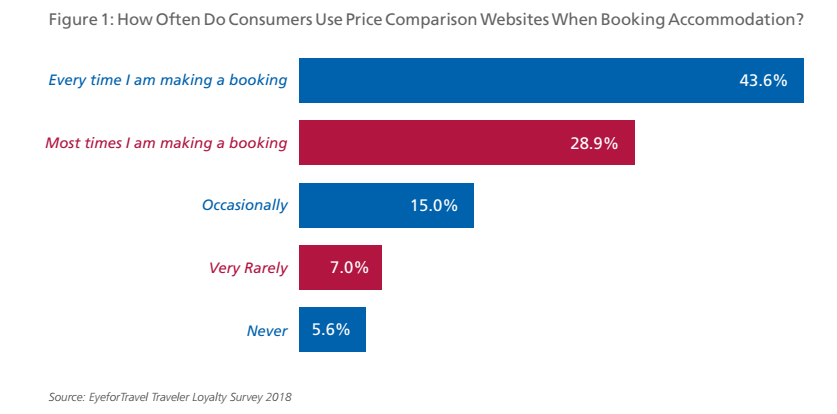
This is allowing OTAs to dominate the space, one which is increasingly crucial for attracting consumers. More than 90% of consumers report using meta sites for price comparison when booking accommodation but the vast majority of bids and outbound traffic from these hugely popular sites, including Google, TripAdvisor, and trivago are benefitting Online Travel Agencies (OTAs) finds the white paper.

Furthermore, hotels are being undercut by both their contracted OTA partners and by third parties working without agreements. The research finds that contracted OTAs are undercutting by an average of 5-6% on meta sites and by an even higher 10-11% by non-contracted OTAs. This means the consumer, who is largely driven by value, is frequently seeing better rates than hotels direct bids, meaning wasted spend and lost data and brand loyalty. When the consumer is searching 14 days or less out from their stay, the research found that they would see a lower bid the majority of the time from multiple actors.

This is a battle for hotels as the average hotel usually falls short of the labour and technological resources to do so. Furthermore, as Fornova CEO Dori Stein points out, there’s no way for a hotel’s revenue or e-commerce manager to know what meta engines are showing their guests in different countries because of the varying IP addresses. “Unless the hotel has a way to monitor its top inbound source markets, it’s a losing battle,” he added.

Chatchai Pongprapat, assistant vice president, revenue management  at Dusit International appreciates the issue, “There is crossover between all of the different players on various channels and that makes it very hard to maintain rate integrity,” he said. The company’s solution has been to partner with Fornova, which polices the rates and helps Pongprapat to maintain rate integrity and partner behaviour.

More effective monitoring and activity on metasearch sites can have a very real effect on the bottom line: “We felt we weren’t featured very visibly as their models evolved and so we hired a third party that could constantly monitor our meta campaigns and make them effective programs,” said Preferred Hotels & Resorts, Global Vice President, Revenue Optimization, Rhett Hirko. Meta-driven bookings jumped 30% after Preferred began working with a third-party partner to manage meta campaigns. They determine the best ROI from each individual meta site based on the budget Preferred dedicates to the channel, as well as meta sites’ performance for Preferred based on click-through volumes. Hirko noted that in terms of how cost effective the move was, “it took a while to tweak the program, but we’re definitely getting good returns for our investment.”

For more on how metasearch is shaping the digital accommodation market, download the free white paper now.

This white paper, made in conjunction with Fornova, gives real-world data on hotel, wholesaler and OTA bidding strategies, alongside consumer behaviours, and meta success metrics. Use these to understand the channel, the competitive landscape and build a winning strategy!

Learn the following from this white paper:
  • The state of the metasearch market.
  • Market penetration rates among consumers and hotels.
  • Consumer behaviours on metasearch.
  • OTA bidding strategies.
  • Techniques to succeed on metasearch.
  • The outlook for meta.

Thursday, 6 December 2018

Why every company should put extra effort into customer analytics

The opportunities for business to extract customer data are expanding. Therefore, today’s business imperative is to enhance customer analytics. This is a guest post from Datumize.


The opportunities for business to extract customer data are expanding. Therefore, today’s business imperative is to enhance customer analytics. This is a guest post from Datumize.
Now, companies can gather data from numerous interactions and devices. ​From cell phones to tablets, computers to cashregisters, customers are continuously generating data.​ Furthermore, data is produced in both structured and unstructured forms. For example, traditional data sources like conversion records are now complemented by unstructured data generated by social media interactions. The sources are so numerous that some businesses can find processing the volume of data a challenge. Therefore, developing an integrated overview that reveals connections between these sources is crucial to enhance insights.

Deploy customer analytics to gain the advantage
According to research conducted by Harvard Business Review,​ ​this intelligence is key to a competitive edge in today’s market.​ Harvard Business Review’s report shows how data is creating added value for both businesses and consumers. By interviewing a cross-section of academics, data scientists and executives, Harvard they found that:
Companies with comprehensive customer analytics across all sources were generating ​up to 8.5 times more shareholder value.
Whilst many companies use data to optimize operations or sales, ​meaningful differentiation comes from customer service​. Through these insights, businesses can better understand their customers’ needs and orient business operations around those needs.
60% of executives reported that siloed data was the greatest barrier to detailed customer analytics​. To overcome these obstacles, businesses are creating agile teams that develop solutions with customer experience at their core. Data is valuable, but it is of little use if businesses cannot analyze the information effectively.
Therefore, companies need to ensure they have the right toolsto visualize and interpret data. ​These tools are increasingly accessible, making it possible for less data-literate operations to leverage insights independently from data scientists, in spite of their continuing importance.

Meet customer expectations through data
Previously, many companies have adopted a product-centric attitude to data. Essentially, this approach generates value for the business as opposed to the customer. For instance, ​airlineswere trailblazers in dynamic pricing models​ that adjusted ticket prices according to demand. However, the new business imperative is customer centricity. This is because ​an increasingly competitive market means that service is now the primary product differentiator. ​Today, consumers expect every interaction to be instantaneous and seamless. Meeting these new expectations requires robust analytic capabilities that enhance customer experience. In contrast to many airlines, hoteliers are using data to strive towards meeting customer expectations. For instance,​ ​Ritz-Carlton Hotels aredeploying data to generate added value for their customers.​ Their ​data tools track customer requests, so they could predict future requirements.​ So, to illustrate, if a customer requests a hypoallergenic pillow, Ritz can ensure they have one available for every stay in the future.

Reap the benefits of advanced analytics
To ​profit from customer analytics​, ​C-levels need to implement technology and business cultures that make interfacing with data seamless.​ For example, marketing managers need to ensure data about customer interactions with marketing content is readily available. From here, they can use data to personalize campaigns and offers. Furthermore, sales departments need intuitive tools that make actioning insights more straightforward.​ Once these capabilities are in place, business can begin reaping the benefits identified by the Harvard Business Review.

Tuesday, 4 December 2018

Wholesalers are the biggest issue in hotel distribution

Hotels and OTAs are being undercut on the overwhelming majority of OTA searches by non-authorised players looking to capitalise on price competitiveness finds a new white paper. 


Fornova and EyeforTravel’s new white paper has uncovered that the greatest factor impacting rate integrity is contracted wholesalers, which are selling inventory to Online Travel Agencies (OTAs) that do not have direct agreements with hotels. This is resulting in lost market share and revenues for both hotels and partner OTAs. The depth of this is revealed by Fornova monitoring of nearly 10 million shops made through metasearch engines in 2018.

Contracted OTAs on average undercut hotels in 14% of the shops with leads times less than 14 days and in 26% of shops with leads times above 14 days. However, when it comes to non-contracted sellers, the share of shops that were undercut doubled or trebled, depending on the time frame. 39% of hotels’ direct rates advertised on meta were undercut by these actors for stays less than 14 days rising to 74% for those with lead times above 14 days

Furthermore, non-contracted OTAs are undercutting more aggressively than contracted counterparts. On average, OTAs working under agreements with the hotel posted rates that were 5% to 6% lower than the direct rate. This jumps up to 10% for non-contracted sellers advertising for lead times under 14 days and 11% for lead times above 14 days

The majority of this is coming from wholesalers moving on inventory, which is then posted by other sellers. Fornova CEO Dori Stein estimates that 40% to 50% of hotel inventory contracted to wholesalers is leaked online, despite the fact that they negotiate for static rates, based on the fact that those rates will be opaque to consumers who are purchasing the room as part of a package with other services included.

The growth of APIs has allowed more players to access and market inventory to more partners but this is not necessarily in the hotel’s best interest. Hotels need to have a view on who is selling their inventory and at what price to protect their brand’s integrity and also to prevent their prices being consistently undercut by wholesalers who should not be placing inventory in this manner. Failing to do so means hotels cannot understand the true effectiveness or cost of their marketing and sales efforts and for consumers to shift away from seeing value in making a direct booking.

The issue is ongoing for Thailand-based Dusit International, which operates primarily in Southeast Asia and which maintains static contracts with a multitude of traditional wholesalers. “There is crossover between all of the different players on various channels and that makes it very hard to maintain rate integrity,” said Chatchai Pongprapat, assistant vice president, revenue management. The company’s solution has been to partner with Fornova, which polices the rates and in turn, Dusit tackles rate disparities one-by-one as they arise, while also reconsidering the terms and conditions of individual static contracts in order to keep the hotels from being undercut.

However, resolving each rate discrepancy doesn’t necessarily remedy the issue in the long-term. The third-party vendor will rectify the issue at the time it occurs says Stein, but without contractual obligations, the partner isn’t necessarily obligated to maintain parity in the long-term. Plus, they will often change the rate in the local market where the hotel’s revenue or distribution team is located, while leaving incongruent rates in international markets as it’s more difficult for the hotel to verify that the changes have been made. According to Fornova CEO Dori Stein, “when hotels have a bad parity situation and they’re on meta, they’re effectively paying to tell the world that their brand.com rates aren’t the cheapest.”

For more on how metasearch is shaping the digital accommodation market, download the free white paper now.

This white paper, made in conjunction with Fornova, gives real-world data on hotel, wholesaler and OTA bidding strategies, alongside consumer behaviours, and meta success metrics. Use these to understand the channel, the competitive landscape and build a winning strategy!

Learn the following from this white paper:
  • The state of the metasearch market.
  • Market penetration rates among consumers and hotels.
  • Consumer behaviours on metasearch.
  • OTA bidding strategies.
  • Techniques to succeed on metasearch.
  • The outlook for meta.

Wednesday, 28 November 2018

Is Google the dominant player in hotel search?

Google is eating up more and more of the pie when it comes to hotel metasearch says new research


A new white paper from EyeforTravel and Fornova finds that Google has picked up plenty of fans in the hotel industry, with it leading the pack for hotel presence on the platform.

Fornova monitors 8,000 hotels across a number of metasearch sites, making regular searches to monitor the space. Fornova's monitoring across Q2 2018 found that when it came to direct ads from hotels on monitored sites, Google scored highest with 80% of searches featuring a direct bid, compared to 43% for HotelsCombined, 30% for Trivago, and just an 8% presence of direct hotel bids on TripAdvisor. It seems that Google has captured substantial market share, and offers a strong value proposition for hotels, as other sites appear to be dominated by OTA bids.

This added competition and is putting pressure on the results of other metasearch sites. Jafar Alam, Senior Product Manager for Fornova, expects more hoteliers will turn to Google Hotel Ads as they look to expand their meta presence because “TripAdvisor and trivago have run into financial difficulties and haven’t been making it work commercially.”

trivago has had the toughest year so far and is in the midst of adjusting its strategy. The company saw its value plummet across the middle of the year as revenue growth turned negative, reversing exceptional growth in 2017. Diminished growth has been put down to a stronger competitive environment and a pull-back in spending from some of its biggest spenders, including Booking Holdings’ brands. This has forced trivago to announce a shift away from its hefty marketing budget and instead to focus on profitability.

TripAdvisor is also having a mixed year. Whilst its stock value was up from the start of 2018 at the time of writing, results from the hotel sector across the year have been less than positive. It reported in its second quarter results that revenues derived from hotels declined by 4%. This fits into a longer-term picture of struggling to raise revenues from the hotel sector, which is especially concerning for the brand given how powerful it is for the discovery and research of accommodation by consumers.
The best performer out of this big three appeared to be the metasearch brands of Booking Holdings, which reported in its second quarter earnings call that revenues from meta and OpenTable grew 34% in Q2.

Fornova CEO Dori Stein theorized that the meta sites struggling to meet financial projections are victims of Google’s advantage as holders of what he called the most sought-after real estate in the Western World. “TripAdvisor and Trivago’s share prices aren’t doing that well and they’re spending more and more on advertising so that they can reach more consumers,” he noted. “But it’s coming at tremendous costs while Google is increasing the number of consumers exposed to their metasearch engine with no real additional costs. No one said it’s a fair world.”

Google is sitting on its laurels, however. After upping its game earlier this year by improving its mobile hotel search experience with enhanced booking capabilities, price filtering, amenity details and automated comparisons, Google, more recently bettered its hotel ads platform. In July, the search engine announced that later this year, hotel ads will become part of the Google Ads platform with a new campaign type. The change will allow management of hotel campaigns in a single platform, alongside advertisers’ other Google campaigns. A new Hotel Center, rolled out at the same time, aims to simplify the management of hotel price feeds and the company appeared to be experimenting with putting Hotel Ads above its usual top-listed paid ads in mid-2018. 

Therefore, other meta players need beware that the Google juggernaut is making inroads into this critical market and will need to fight hard to capture the critical hotel marketing spend and become less reliant on other online travel agents.

For more on how metasearch is shaping the digital accommodation market, download the free white paper now.

This white paper, made in conjunction with Fornova, gives real-world data on hotel, wholesaler and OTA bidding strategies, alongside consumer behaviours, and meta success metrics. Use these to understand the channel, the competitive landscape and build a winning strategy!

Learn the following from this white paper:
  • The state of the metasearch market.
  • Market penetration rates among consumers and hotels.
  • Consumer behaviours on metasearch.
  • OTA bidding strategies.
  • Techniques to succeed on metasearch.
  • The outlook for meta.

Monday, 26 November 2018

94% of travel consumers compare hotel prices on metasearch


Metasearch is now critical to the travel research process finds a new white paper, with 94% of travelers reporting that they use metasearch when booking hotels and 73% doing so regularly. 


A new white paper from Fornova and EyeforTravel finds that 94.4% of consumers use price comparison sites at least occasionally when booking their accommodation. Within this, 72.5% of consumers across the countries surveyed said that they regularly used metasearch sites and 43.6% said that they always used the tools. The results come from an EyeforTravel survey of over 3,000 travel consumers across Australia, Canada, the United Kingdom and United States, and you can access the complete report for free by clicking here now.

This puts metasearch at the forefront of the consumer research process and makes it a critical area to compete within. “Metasearch offers price comparisons that show consumers where they can get the best deals available and there is demand for this among leisure travelers,” said Ujjwal Suri, vice president, distribution solutions at Fornova. Indeed, when consumers were asked what made them come back to travel brands again and again to use, the value proposition came out head and shoulders above other factors, with 62% of respondents saying that the companies offering the best value were where they returned to. The next highest category was the digital consumer experience at 32.4% of travelers.

Looking closer at consumer trends, Millennials and business travelers are some of the heaviest metasearch users.

Travelers between the ages of 18 and 35 are the group most likely to report using price comparison tools every time they book accommodations at 46.4% of the demographic cohort, while those aged 36 to 55 are just behind at 45%, whereas the oldest generation of over 55 years see a noticeably lower 36.8% reporting that they always use metasearch sites.  

Business travelers also far outpace their leisure counterparts for meta use, at 47.4% comparing rooms every time they shop for a room, compared with 37.4% of those who have not made a business trip in the last 12 months. Some 30% of business travelers also report using meta ‘most times’ they book lodging, compared with 27.2% of leisure travel consumers.

For more on how metasearch is shaping the digital accommodation market, download the free white paper now.

This white paper, made in conjunction with Fornova, gives real-world data on hotel, wholesaler and OTA bidding strategies, alongside consumer behaviours, and meta success metrics. Use these to understand the channel, the competitive landscape and build a winning strategy!

Learn the following from this white paper:
  • The state of the metasearch market.
  • Market penetration rates among consumers and hotels.
  • Consumer behaviours on metasearch.
  • OTA bidding strategies.
  • Techniques to succeed on metasearch.
  • The outlook for meta.